
Of Werewolves & Demons
March 22, 2024
Horror Scores: An Interview with Will Bates: Larry Fessenden’s BLACKOUT and Michael Mohan’s IMMACULATE

Interview by Randall D. Larson
BLACKOUT (March 2024)
Directed by Larry Fessenden: Charley’s secret is he thinks he’s a werewolf. He can’t remember the things he’s done, but the papers report random acts of violence taking place at night in this small upstate hamlet. Now, the whole town must rally to find out what is tearing it apart: mistrust, fear, or a monster that comes out at night. The thriller, which premiered at last year’s Fantasia Film Festival, just opened this past Wednesday in New York by Dark Sky Films and will make its VOD debut in April. The soundtrack is available via Amazon and other streaming sources. – via Film Music Reporter
Watch the BLACKOUT Trailer:
Q: You’ve worked with Larry Fessenden previously, notably on his unique films BENEATH and DEPRAVED, and now with BLACKOUT. What does he look for in music for his movies?
Will Bates: I feel very fortunate that the first horror movie I ever scored was for Larry. He told me a lot about how to work with the genre, and we connected over this sense of elegy and pathos and almost tragedy with horror. I feel like that’s something the filmmaking is embracing with BLACKOUT. Scary things for Larry are more frightening and disturbing if a certain amount of tragedy is involved, and music has a compelling way of portraying that. We’d already developed a great shorthand and language when we worked on BENEATH and then DEPRAVED – this is my third film with him. I consider him a dear friend at this point. One of the great benefits of working with people repeatedly is that you start to trust each other, and he let me play with the tone of this movie and experiment. I adore him for that. He’s a very loved man, as I’m sure you know.
Q: BLACKOUT is a unique werewolf story based on Larry’s audio play of the same name. What was he looking for in the music for this film?
Will Bates: Whereas, with DEPRAVED, he talked a lot about the brain, synapses, and electricity. With BLACKOUT, we wanted to be more organic and more of an expression of the woods and memory. We talked a lot about memory. In the end, the subtext of this film is just that. What happens to a werewolf and the literal blackout of the transformation? So I think, in terms of the instrumentation, it was very organic – lots of horns, woodwinds, and guitars, which is a new thing for me with Larry. We’ve never really done guitars in his scores before. There are no synths, none of that; there’s hardly any electronics. Maybe towards the end, when things get a bit crazy, I’d start reaching for some of those tools, but overall, it’s very raw, Lots of strings – and when I use the strings they were recorded very close to the instrument. It’s a very dusty feeling, natural and scratchy. One thing I could do here that I hadn’t done too much before was… I recently reconnected with a double bass player named Gary Wicks [ https://www.garywicks.com/ ], a jazz musician. I’m a reformed jazz musician myself. Gary’s an excellent upright bass player, and he did a lot of great arco (bowed playing) with his instrument and used his instrument to create crazy crunches and sound effects. Larry always wanted churning, crunching bones – like “let’s get that feeling like the hair is coming out of the skin and all of that stuff, which is so visceral with werewolves. The double bass became a thing that I gravitated toward a lot, and I looked to Gary to work on almost every cue on this one.
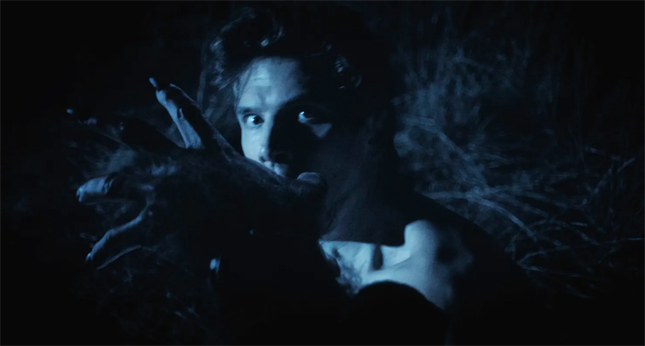
Q: I want to ask you about a few particularly interesting cues. “Howl” is just that, a mix of sonic howls and roiling brass, followed by “Jail Break,” which added its own sonic confrontation of sounds…
Will Bates: Wow, that’s a great description! This movie was also interesting in that, while Larry was editing, he wanted a tool kit of stuff, which is a way that we’ve worked together in the past. We’d talk about themes for characters, like the significant tent-pole cues for the movie, and I’ll work on those. But alongside those, he always had stuff to play with, and I tend to write that way, anyway. I’ll throw lots of things at the page and lots of sketches, which tends to be my journey to find those big themes. The sketches always end up being useful, especially with a filmmaker like Larry, who likes to use music while he’s editing, and sometimes I’ll give him the stems for those sketches.
Q: When you take a howl from a wolf and stretch it, you can identify individual notes and tones layered. I started to write around the shape of the howling melody,
“Howl” was one such thing. I thought of finding recordings of wolves, sketching them, and pitching them to make this an even richer tapestry of layered notes. When you take a howl from a wolf and stretch it, you can identify individual notes and tones layered. I started to write around the shape of the howling melody, and that’s what that piece is. I isolated it into a fifteen-minute section, stretched-out wolf howl, and then orchestrated it. That’s what that piece is, and then added Gary’s bass and a few other things – and then, of course, the horns. Larry’s one of the only filmmakers who doesn’t make me take the saxes out, so I’m always reaching for the horns, knowing he’ll love it! That’s always reassuring!
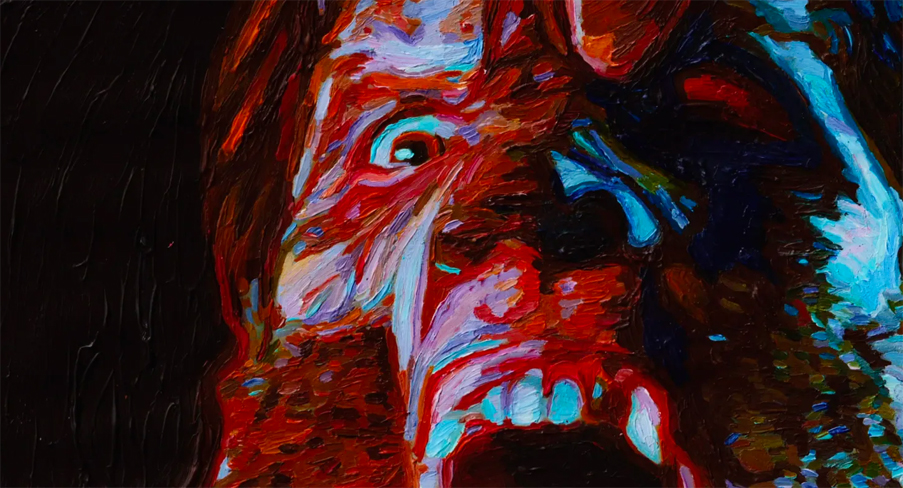
Q: “Charley’s Theme” reprises the opening “Charley’s Leaving” with a more delicate sound…. along with “The Ballad Of Talbot Falls,” a kind of jazz interpretation of the previous melodic arrangements.
Will Bates: That’s right, yeah. Again, I’m sort of betraying my background a little bit with that one, I suppose. Larry isn’t afraid of that raw emotion. He’d say… “You’ve got this theme, just do it, man! Make it big and bold and as emotional as it can be. I love that; it’s a wonderful note for a composer to have.
Q: The concluding song nicely completes the film, with Charlie singing a personal ballad that sums up his experiences throughout the story. How would you interpret the movie yourself from this perspective?
Will Bates: I think, for me, there’s such a sadness about the werewolf. Having to leave that life behind and not even having an awareness in your waking state of what you have been enjoying as this creature. That’s the feeling I get – this sense of regret and longing. It’s deeply sad. I can’t think of a werewolf movie that’s not that way. It’s a certain kind of tragedy, and there’s a beautiful love story in this as well, and having to leave here behind. So, yeh, I think loss, and that was kind of the brief, too, this elegiac idea that we’re left with in the movie.
Listen to “Charley’s Theme” from BLACKOUT:
IMMACULATE (March 2024)
Directed by Michael Mohan and starring Sydney Sweeney as Cecilia, an American nun of devout faith who embarks on a new journey in a remote convent in the picturesque Italian countryside. Cecilia’s warm welcome quickly devolves into a nightmare as it becomes clear her new home harbors a sinister secret and unspeakable horrors. The film premiered at South by Southwest on March 12, 2024, with its theatrical wide debut on March 22, 2024.
Watch the film’s trailer:
Q: What can you tell me about IMMACULATE with Michale Mohan, for whom you previously scored THE VOYEURS in 2021? How did you and he arrive at the kinds of sounds you were looking for in this film?
Will Bates: This was an interesting one. I was involved very early in this one, at the script stage. He put a playlist together right when we first started, and we began talking about references and all sorts of stuff. We talked about this a few nights, again, and he was, like, “Did you just throw all those references away in the end?” [mimicking nodding his head] “Yeah! We did it, and we had that conversation and then very quickly departed from it because I think we found a tone for the movie together.”
It was based on certain things that needed to be achieved before and during the shoots. They required a hymn for the nuns to sing on camera when they were on set. Early in the film, there’s quite an elaborate scene where they’re all singing in this monastery. He wanted it to be a reflection of Sister Cecilia – Sydney Sweeney’s character – of the kind of magical feeling she gets when she arrives at the convent; a certain amount of awe, her spirituality towards God, but also something slightly off and weird. I suggested, “How about a Te Deum mass? I’ll take the Latin text and write a Te Deum mass.” And he’s like, “Great! I don’t know what that is, but do it!”
So I started doing it. My 15-year-old self did high school Latin – I needed to enlist some help with the grammar – but I wrote this hymn, and it just seemed to dictate many of the other choices we made in the movie. Another thing that he needed was when she arrived on the scene. Right before that, a group of nuns were in a courtyard, and they were playing instruments. The script says, “A trio of nuns are playing music.” He goes, “What do you think it should be?” I said, “Well, it’s sort of an ancient sub-sect of the Catholic church, so it should be familiar, but maybe also it should be like somewhat stopped in time, so what about a hurdy-gurdy, a psaltery, and a zither? Then he said, “Great!” and sent his props guy into Rome to source these instruments, and then, of course, I had to do the same thing! So, I started writing sketches using that instrumentation. Then again, rather like with Larry, I provided these sketches so that when he got back to the U.S. and was editing, he had stuff that he could try out. Though those choices and that hymn, and then taking that as the kind of foundation of where the story begins, and then using those melodies as a way to change the context as we learn more about this cult corner of the Catholic church and convent – using it to be the dark journey. I think that was it. It starts with an essential requirement of what we would need to shoot with.

Q: Your primary instrumental elements, especially the electronic figures and what I’m describing as harsh echoes, metallic scrapes, and the like, were very influential throughout the score, the church part, and some intense, dark stuff. I thought that was fascinating to listen to.
The thing about a square grand is it was in the day just before they figured out how to put the harp vertical, so it’s a pair of two-layered harps. It’s like a shortened grand piano with two harps, one on top of the other, making it ideal for prepared piano. So I’m scraping my fingernails along it. I’m using ebows [electronic bow] on the strings and a mallet. The movie’s first act is just this piano and nothing else, so it became an incredible tool! And, side note, it used to belong to General Phineas Banning, one of the founders of Long Beach and the Port of Los Angeles [1930-1885]! I told Mohan this in a text, and he said, “Whoa! That’s amazing! Send me a photo of the piano!” I sent him a photo, and he asked, “When did you do most of the recording?” I said, “Yesterday!” And he said, “General Phineas Banning’s birthday was yesterday!” Spooky! The ghost of Phineas is in this movie, I guess, somewhere!
Will Bates: Thank you. Yeah, about halfway through the process, my wife – who’s been going to these estate sales here in L.A., just looking for antiques and weird odds and ends – and I went to one with her, and there was this piano, a square grand, that was sitting in the corner. The woman running the estate sale said, “You’d like a look at that, wouldn’t you?” I said, “No, no, it’s fine.” She said, “Well, if you don’t take it, it’s free, and we’re going to take a chainsaw to it because we can’t figure out how to get it out of the building. Do you want it?” And I was, like, “Ohhh… yeah. If you’re going to destroy it. That’s awful.” So I found a guy who told me it was a 19th-century square grand piano. He figured out how to take the legs off it, and he got it back to my house. I had a piano tuner come and look at it, and he said, “This thing is unbelievable. It belongs in a museum! You’ll never be able to tune it. It hasn’t been tuned for probably a hundred years and will probably fall apart!” I said, “Okay!”
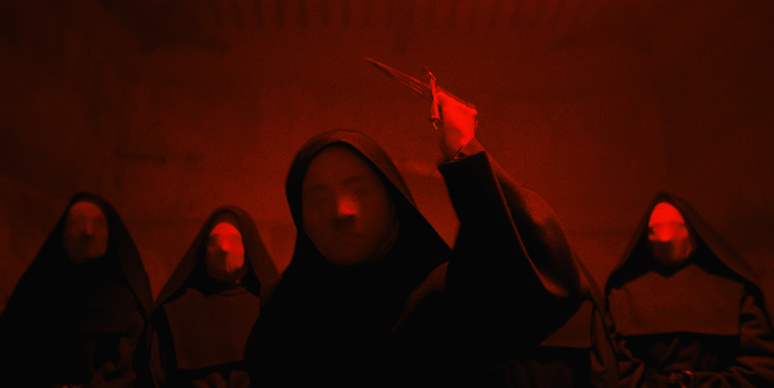
Photo Courtesy of NEON
Q: There’s an interesting mix of treatments here, too—from the sonic patterns of “Red Veiled Nuns” to the very pleasing melody of “Death Is A Part Of Everyday Life,” the twanging echoes of “Vows,” and the rhythms of “The Te Deum.” How did you create these ringing patterns and such to develop some very frightening tonal gongs, rhythmic elements, and percussive musical structures?
Will Bates: Yeah! At another estate sale, we got another piano. That’s crazy! My assistant calls it “The Piano Farm!” It’s garaged now because when we picked up the square grand, they told me, “There’s an upright Steinway in the garage. Do you want that one?” I said, “All right!” So I grabbed that one and got this gorgeous Scottish piano, which is very similar, but I can’t tune it. The hammers no longer connect with the strings, but I used them on IMMACULATE. Any time there’s a cue that needs momentum and pulse, I use that thing. I’m basically using that piano as percussion for all these planks and crazy, harsh sounds. It wasn’t something we discussed, but it just seemed to make sense that there were never any rhythms that landed in a standard meter if that makes sense, and also anything that’s very electronic. I wanted it always to be mechanical and machine-like but never synthetic. Those rhythms are pretty pointed and articulate but also very wonky!

Q: Where did the orchestral instruments and singers record for the score?
Will Bates: We were lucky to get this wonderful choir in London called the Hi Lo Singers. They did the bulk of the singing, and my singer, Maiah Manser, who has recorded for me on a bunch of different scores, is the soloist.
Q: So, what’s coming up next that you could discuss?
Will Bates: I have Season 2 of the MAYFAIR WITCHES. It was much delayed because of the strikes, of course, but they’re in production right now, so that one’s coming down the pike. And then I did a documentary, I think it was last Fall, called CATCHING FIRE: THE STORY OF ANITA PALLENBERG. That’s a really interesting story about her and the Rolling Stones and her relationship with Keith Richards.
Many thanks to Will Bates for a detailed and enthralling interview on these films. Thanks also to Alix Becq-Weinstein and Jana Davidoff of Rhapsody PR for facilitating this interview!
The soundtrack album for BLACKOUT is available from Milan Records, at these links. The soundtrack album for IMMACULATE has been released by Lakeshore Records, at these links.
This interview has been edited slightly for clarity or brevity. BLACKOUT images via Rhapsody PR; IMMACULATE images courtesy of NEON, with thanks to all.
See my previous interviews with Will Bates: “Will Bates and the MAYFAIR WITCHES Score” here, and “Will Bates Meets The DEVIL IN OHIO” here.
Listen to “Our Lady of Atonement” from the IMMACULATE score via YouTube:




 Musique Fantastique